How to Get More Organic Leads for Your Kentucky Home Services Business
Getting more organic leads for your Kentucky home services business comes down to a short list of things that actually work, and a long list of things you can ignore. Most contractors get that backwards. This is the 20% that brings in the calls.
By Josh Sloan · From Louisville, KY
Key takeaways
Your Google Business Profile is the single biggest lever. Claim it, fill it out completely, and keep it active before anything else.
Geo-tag your pages. Build one real page for each Kentucky city you serve, and never clone one page and just swap the city name.
Chase bottom-of-funnel searches like "roof repair Louisville" instead of "what is a roof." They convert better and rank faster.
Ask for a Google review after every job. Recent reviews beat a big pile of old ones.
Keep your name, address, and phone identical everywhere online.
Skip the busywork like schema obsession and canonical rabbit holes. It's not what's stopping you.
First, the 80/20 of local SEO
Twenty percent of the effort drives eighty percent of the results. That's the Pareto Principle, and local SEO is no exception. When I started out I burned weeks on things that turned out not to matter, like fiddling with schema markup and chasing the perfect canonical-tag setup. For a home services business trying to get found in Kentucky, almost none of that moves you. What follows is the part that does. If you're not running a giant site or doing something exotic, you can ignore the rest.
If you would rather have this as a monthly routine than a list, GISuser ran a piece on how to rank number one in your city with four hours of work a month. It puts survey numbers on where those four hours should go, roughly a third of map pack weight on the Google Business Profile and a fifth on reviews, and it follows the same Shelby County landscaper you will see further down this page.
1. Start with your Google Business Profile
For a home services business, your Google Business Profile is the single highest-leverage thing you own. It decides whether you show up in the "map pack," the three businesses Google drops onto the map at the top of local results, and that's where most of the clicks go.
Claim it, verify it, and fill out everything: the right primary category ("HVAC contractor," "Roofing contractor," "Plumber"), your hours, photos of real jobs, and the Kentucky cities you serve. Then keep it active by posting updates, adding photos, and responding to reviews.
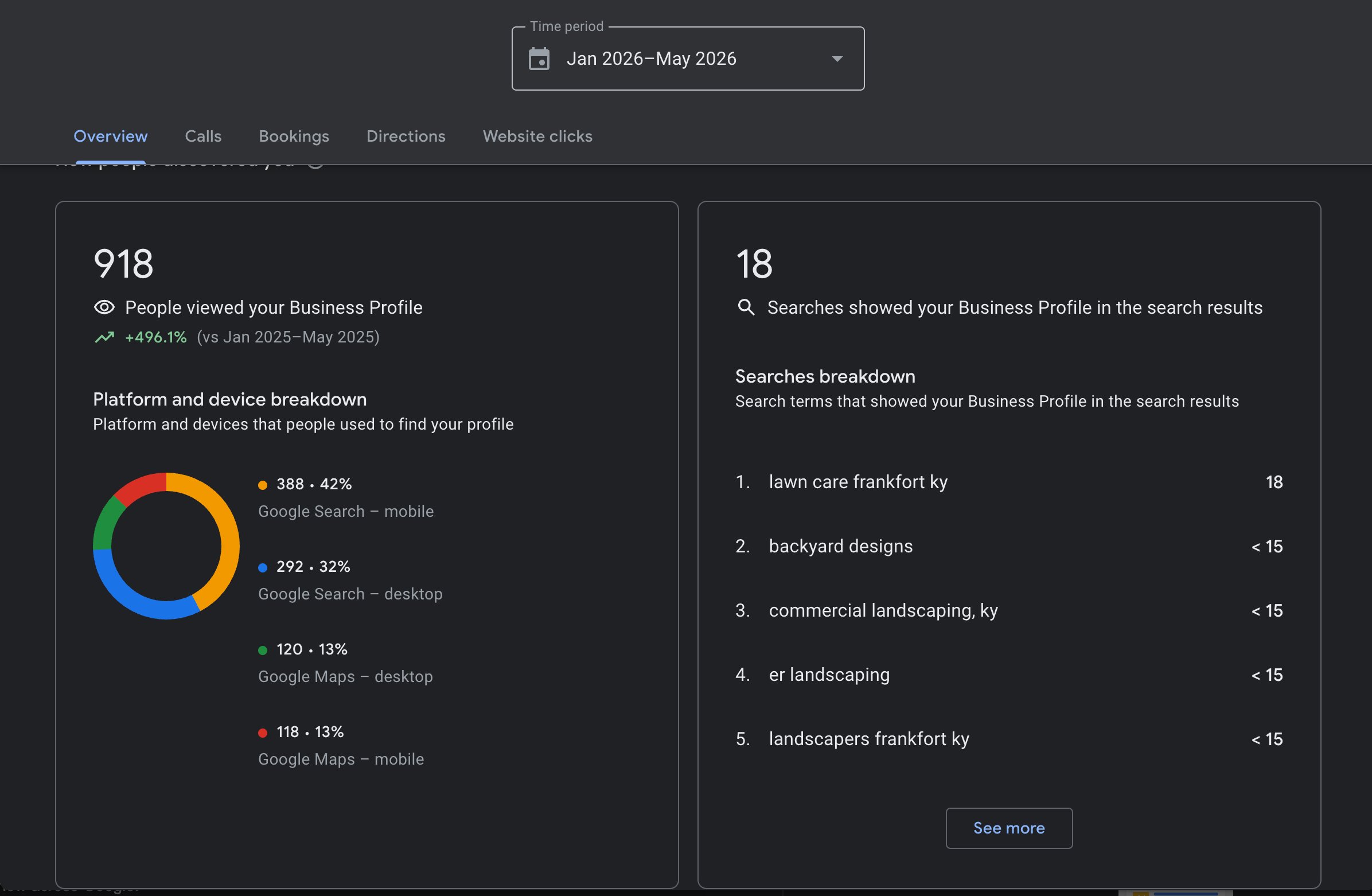
The payoff is real. For the veteran-owned Shelby County landscaper above, optimizing and staying active on their profile pushed Google Business Profile views up 496% year over year, website clicks from the profile up 312%, and calls straight from the profile up 1,000%.
Google Business Profile views up 496% year over year. The map pack is where local home-services clicks live.
2. The only technical SEO you actually need
Here's the entire technical to-do list for most home services sites: open a free Google Search Console account, connect your site, and submit your sitemap. Every time you add or change a page, paste the URL into the "Inspect any URL" bar at the top and hit request indexing. That's it. If you're on a normal website builder, deeper technical SEO isn't what's holding you back, so don't spend a single weekend on it.
3. Geo-tag your pages: one real page per city you serve
This is where most contractors leave leads on the table. If you drive to customers, and most home services businesses do, you want a dedicated page for each city and service area, with the city worked into the URL, the page title, the H1, the first sentence, and the meta description. That's how Google knows you're the plumber in Elizabethtown instead of a plumber somewhere in Kentucky.
One rule, and it matters: each page has to be genuinely its own, with real jobs you've done there, your response time, local landmarks, a photo or two. Take one page, copy it, swap "Louisville" for "Lexington," and you've built a doorway page. Google filters those out, and it can drag down the rest of your site.
A page can also target who you are, on top of where you work. That same client's veteran-owned lawn care and landscaping page targets the specific buyer who wants to support a veteran-owned business, a real value proposition that matches what a slice of customers are already searching for. That one page brought in a real lead in its first month live, and as the new service and county pages ranked, the business ended up visible across all five counties it serves: Shelby, Jefferson, Franklin, Anderson, and Henry.
There are two kinds of keywords. "What is landscaping" is a question that pulls in students and tire-kickers. "Landscaping company in Shelbyville" or "how much does lawn care cost in Louisville" is a person with their wallet out. Go after the second kind: "[trade] [city]," "[trade] near me," "[service] cost." They convert better, they're easier to rank for, and increasingly they're what gets AI assistants to recommend you.
That cost-question angle is a quiet winner. When we answered the actual questions people ask Google, the "People Also Ask" ones, including what a service costs in a given city, those pages started picking up impressions and clicks inside the first week.
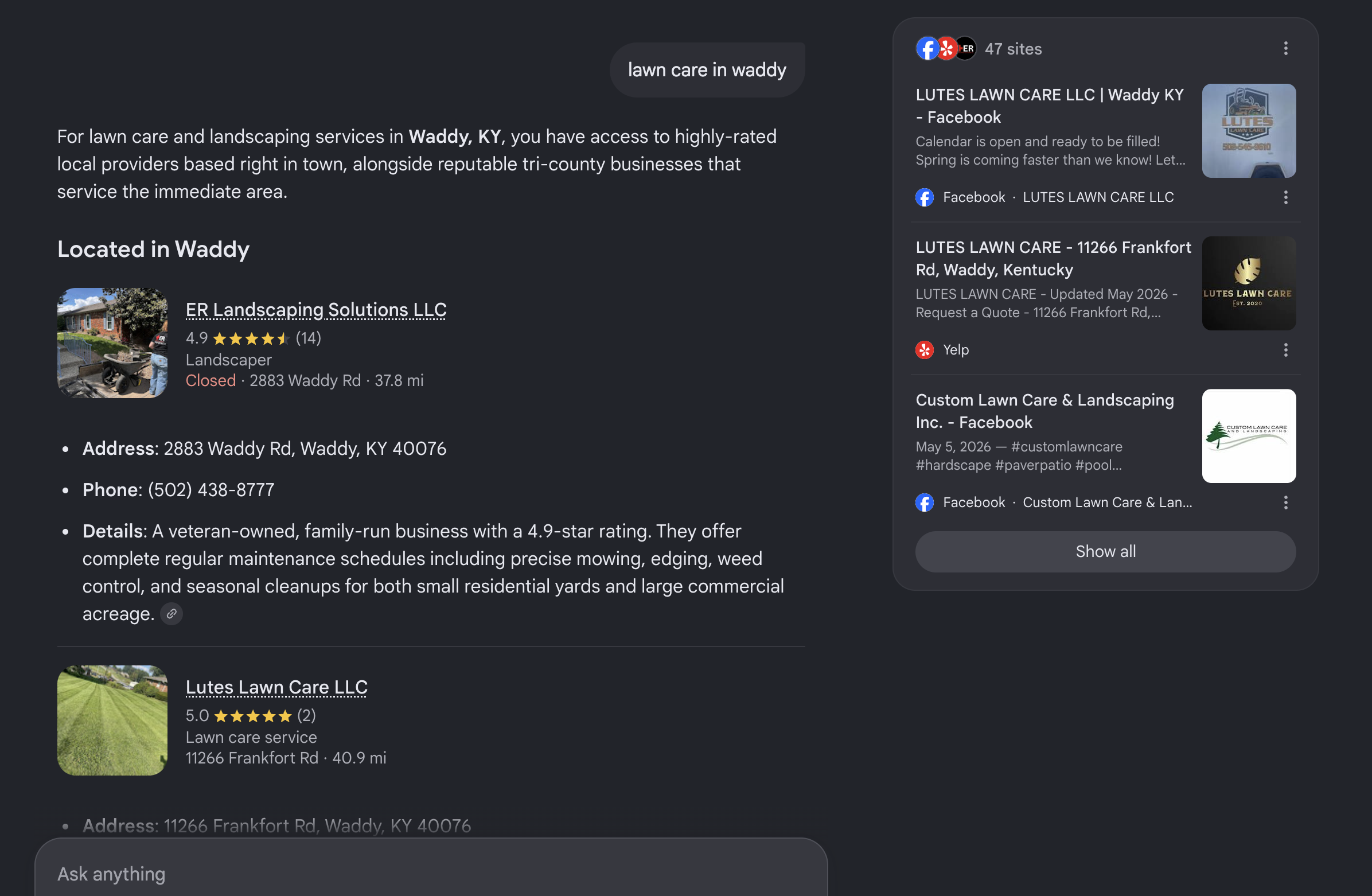
And it compounds into AI search. Ask ChatGPT for lawn care in Waddy, Kentucky, and our client comes up first, ahead of businesses that have been in town for years.
Bottom-of-funnel, local pages don't just rank on Google. They're what AI assistants recommend, too.
We took a veteran-owned Shelby County landscaper from 3 to 166 organic visitors.
That's what the 20% here looks like when a real Kentucky home services business actually does it. Six months, before and after.
✓Total organic visitors
166
Last 6 months
3
Previous 6 months
✓Total impressions
10.4K
Last 6 months
176
Previous 6 months
In the same stretch, calls straight from their Google Business Profile jumped 1,000%, twenty-one people asked for a quote, and six became new paying customers in the first three months.
5. Get reviews, and keep getting them
Google ranks you against your local competitors, so there's no magic review count. But recent reviews carry more weight than a big pile of old ones, which makes the move simple: ask for a review after every single job. Hand the customer a link before you leave, make it a habit, and keep the flow going. It lifts your map ranking and it closes the next customer who reads them.
6. Keep your NAP consistent and get listed locally
NAP is your Name, Address, and Phone number, and it needs to be identical everywhere you appear: your site, your Google Business Profile, Yelp, Angi, the BBB, and Kentucky directories. Even "St." versus "Street" dilutes the signal. While you're at it, get listed in directories in your niche and your area, like your local chamber of commerce, trade associations, and Kentucky business directories, and use a real, keyword-rich description on each. Those descriptions help tell Google exactly what you do and where.
7. Do you actually need a blog?
You don't need one to rank your core services, but it helps. A handful of genuinely useful, local posts (what a service costs in your city, or how to protect your pipes in a Kentucky cold snap) catch long-tail searches and give you internal links to point back at your money pages. Generic, could-be-anywhere filler does nothing. If you're going to write, make it something a local customer would actually find useful.
The bottom line
You don't need to do everything. You need to do the few things that matter: own your Google Business Profile, geo-tag a real page for every city you serve, chase the searches people make right before they hire, stack up recent reviews, and keep your details consistent. The greatest shortcut in SEO is knowing what to ignore.
How do I get my home services business to show up on Google?
Claim and verify your Google Business Profile, then fill it out completely. Set the right primary category (like "HVAC contractor" or "Roofing contractor"), your hours, photos of real jobs, and the Kentucky cities you actually serve. For most home-services businesses that one profile is the biggest factor in whether you show up in the local map pack at all.
How do I rank higher on Google Maps (the local map pack)?
Google ranks the map pack on relevance, distance, and prominence. You can't change how far you are from every searcher, so win on the rest. That means an accurate category and service list, a steady stream of recent reviews, real photos, LocalBusiness schema on your site, and consistent local citations. The three map results take the biggest share of local clicks, so they're worth chasing.
Why is my business not showing up on Google Maps?
The usual culprits are a profile that isn't verified, a name, address, or phone number that's inconsistent across the web, a listing that got suspended or has a duplicate, too few reviews, or a searcher who's simply outside your area. Work down that list in order. Verification and NAP consistency fix most cases.
How long does local SEO take to work for contractors?
Google Business Profile changes can move within a few weeks. Real ranking and lead gains usually show up in three to six months, with steady lead flow around six to twelve. It also depends on your market. A contractor in a smaller Kentucky town ranks faster than one fighting for competitive Louisville or Lexington searches.
How many Google reviews do I need to rank?
There's no magic number. Google ranks you relative to your local competitors. Around ten reviews gets you in the conversation, and twenty-five to fifty or more helps you compete in busier markets. Recency and steady velocity matter more than lifetime total, so ask for a review after every completed Kentucky job.
Do I need a separate page for each city or service area I serve?
Yes. If you travel to customers, which is most home-services trades, build one page for your home city and a unique page for each Kentucky town you serve. The catch is that each page has to be genuinely different, with real local jobs, response times, and proof. Cloning one template and swapping the city name is a doorway page, and Google filters those out.
What are the most important Google Business Profile ranking factors?
Primary category, complete and accurate business info, reviews (count, rating, recency, and how fast you respond), photos, proximity, your website's authority and schema, and ongoing activity like posts and updated hours. Category and reviews do the heaviest lifting.
Do I need a blog to rank my contractor business?
You don't need one to rank your core services, but it helps. A few genuinely useful, locally-relevant posts, like what a service costs in your city or how to protect your pipes in a Kentucky cold snap, capture long-tail searches and give you internal links to point at your service pages. Skip generic filler. It does nothing.
How do I rank my business in multiple cities across Kentucky?
Give each city its own real service-area page, earn citations and reviews that mention those areas, and keep your NAP consistent everywhere. Your Google Business Profile "service area" setting tells Google where you travel, but it doesn't decide where you rank. The individual city pages do that. And don't invent office addresses in cities where you have no presence.
Why does NAP consistency matter for local SEO?
Your Name, Address, and Phone number should be identical everywhere you appear: your website, Google Business Profile, Yelp, Angi, the BBB, and every Kentucky directory. Even small mismatches like "St." versus "Street" dilute the signal and can quietly suppress your map rankings. It's one of the easiest wins there is.
Want us to build it for you?
We build fast, SEO-ready websites for Kentucky home-services businesses, with geo-tagged pages, an optimized Google Business Profile, and a clear report every month.