Why Your Competitor Ranks Above You on Google Maps (and How to Fix It)
Search your own service in your own town and watch what happens. If a competitor is parked in the top three on the map while you are buried below it, that is costing you real calls, because those three spots take most of the clicks in local search. The ranking is not random. Google decides those spots on a short list of signals, and once you can see them, you can start taking the spots back.
By Josh Sloan · From Louisville, KY
Key takeaways
The map pack, the three businesses on the little map at the top of local results, takes most of the clicks. Those three spots are the whole fight.
Google ranks them on relevance, distance, and prominence. You control two of the three.
Your competitor is almost always winning on their Google Business Profile: a sharper primary category, a more complete profile, and fresher reviews.
You can beat a closer competitor. A real page for every town you serve tells Google you belong in those areas.
Reviews win on recency and steadiness. Six fresh reviews a month beats eighty from three years ago.
Almost everything beating you is fixable, and you can audit it yourself in an afternoon.
The three spots that decide who gets the call
When someone in Kentucky pulls out their phone and types "plumber near me" or "roof repair Louisville," Google shows a small map with three businesses pinned to the top. That is the map pack, or the local 3-pack, and it sits above every regular blue link on the page. Most people never scroll past it. They tap one of the three, call, and book. So the real contest in local search is not page one, it is those three spots and whether your name is in them.
On a phone, the map pack usually sits above where the first screen ends. That is why the Google Business Profile is the first thing worth fixing, and why a page can rank well in the ordinary results and still feel invisible.
How Google actually picks the three
Google leans on three things to order local results: relevance, distance, and prominence. Relevance is how well your business matches what the person typed, which comes mostly from your category and the services on your profile. Distance is how close you are to the searcher. Prominence is how established and trusted you look, which Google reads from your reviews, your website, mentions around the web, and how active your profile is.
You cannot move your business closer to every customer, so distance is the one lever you do not control. The other two are almost entirely in your hands, and that is where your competitor is beating you. The next four sections are the reasons they win, in the order they usually matter.
Reason one: their Google Business Profile is doing more work than yours
When 47 local search experts were surveyed for the 2026 ranking factors, the single biggest driver of map rankings was the Google Business Profile. Not the website, the profile. The two things inside it that move the needle most are the primary category and how complete it is.
If your competitor set their primary category to "Roofing contractor" and you left yours on a vague "Contractor," they match more of the right searches before either of you does anything else. Same story when their profile has real photos, correct hours, a full service list, and a proper description while yours sits half empty. Google hands the spot to the business it understands best.
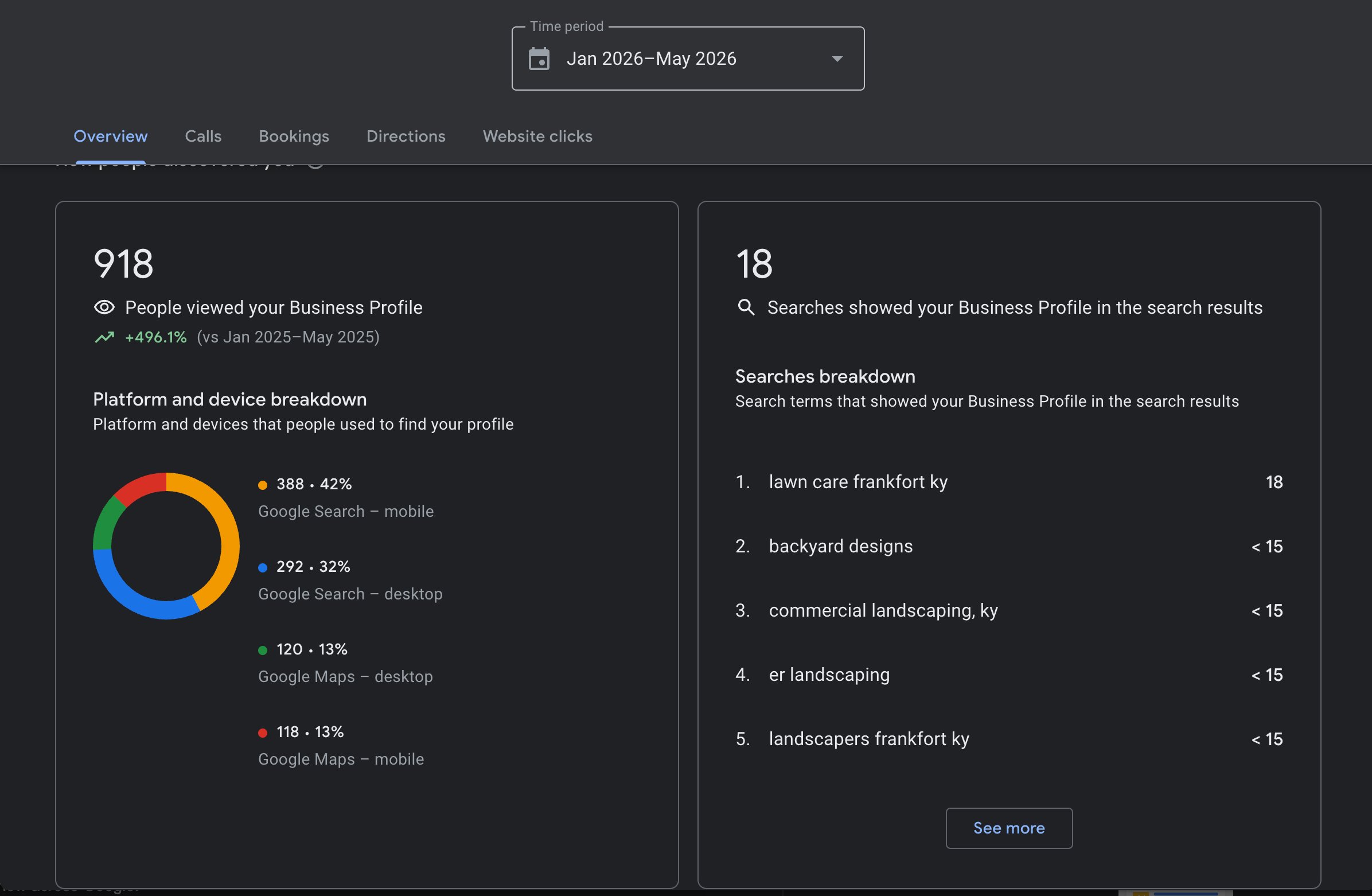
This is the first thing I check for any Kentucky home services client, and it is usually where the fastest wins hide. For one veteran-owned Shelby County landscaper, getting the profile dialed in and keeping it active pushed Google Business Profile views up 496% year over year and calls straight from the profile up 1,000%.
Google Business Profile views up 496% year over year. The profile is the heaviest single signal in the map pack.
Reason two: they are collecting fresh reviews and you stopped
Reviews are the next heaviest signal, and this is where a lot of good businesses quietly slip. It is not about who has the biggest pile. A competitor with eighty reviews from three years ago looks asleep to Google next to one pulling in six or eight new ones every month. Recent, steady reviews say the business is active and trusted right now, and that is what gets rewarded.
The fix is a habit, not a campaign. Ask every customer for a review the day you finish the job, hand them the link before you pull out of the driveway, and reply to the ones that come in, including the bad ones (here is how to respond to a bad Google review). Do that for a few months and you will pass competitors who have twice your total.
Reason three: they are closer, and what to do when you cannot move
Sometimes the honest answer is that your competitor is simply nearer to the person searching, and distance gave them the edge. You cannot pick your business up and move it, and you are not stuck either. Distance is one factor out of three, so you win those searches by being stronger on the other two and by giving Google a real reason to connect you with each place you work.
That means a genuine page for every Kentucky town and service area you cover, with actual jobs you have done there, your response time, and local detail. Google reads those pages to decide you belong in Shelbyville or Prospect, not just in your home city. Building that out, page by page, is the core of our local SEO for Louisville contractors work, and the trade-specific versions like local SEO for HVAC companies, local SEO for plumbers, and local SEO for roofers follow the same playbook.
Reason four: their website is backing up the profile
Your Google Business Profile and your website work as a team. A competitor with a fast, well-built site that clearly says what they do and where, with the right local pages and clean LocalBusiness schema, gives Google more confidence in their profile than a business running an identical profile on a thin or broken website. You do not need a huge site. You need a solid one that reinforces every claim your profile makes, so the two point at the same story.
Real Kentucky Results
A Shelby County landscaper we took from 3 to 166 organic visitors.
Same playbook you just read: a dialed-in profile, steady reviews, and real local pages. Six months, before and after.
✓Total organic visitors
166
Last 6 months
3
Previous 6 months
✓Total impressions
10.4K
Last 6 months
176
Previous 6 months
In the same stretch their Google Business Profile views climbed 496% and calls straight from the profile jumped 1,000%.
How to find out exactly why you are losing
You can diagnose most of this yourself in an afternoon. Open an incognito window and search your main service the way a customer would. Pull up the competitor beating you and set their Google Business Profile next to yours, field by field: primary category, number and recency of reviews, photos, hours, services, and description. Then check that your name, address, and phone number read exactly the same everywhere they appear online, because even "St." versus "Street" can drag you down.
Look at whether they have local pages for the areas you both serve while you have none. If you want a clearer picture than your own phone gives, a local grid ranking tool shows where you land across your whole city instead of just from your couch. Whatever gap you find, it is almost always something you can close, on your own or with a Louisville SEO agency doing the monthly work for you.
The bottom line
Your competitor sits above you because Google understands their business better than yours: a sharper profile, fresher reviews, a site that backs it up, and real pages for the places they serve. It has very little to do with who does better work on the job. Every one of those signals is fixable, and none of it is a secret. Fix the profile, keep the reviews coming, build the pages, and those three spots start opening up.
Why does my competitor rank higher than me on Google Maps?
Google ranks the map pack on three things: relevance, distance, and prominence. Your competitor is usually winning on the ones you can control, like a more accurate primary category, a fuller Google Business Profile, fresher reviews, and a website that backs it all up. Proximity plays a part too, but it is rarely the whole story, and it is the one factor you cannot change.
What is the Google map pack?
The map pack, or local 3-pack, is the little map with three business listings that Google drops at the top of local results. When someone searches "plumber near me" or "roofer in Louisville," those three spots sit above the regular blue links and take the bulk of the clicks and calls. Landing in them is the whole game in local SEO.
Can I outrank a competitor who is closer to the customer?
Often, yes. Distance is only one of Google's three factors. A business a few miles farther out can still beat a closer one that has a weak profile, few reviews, or the wrong category. You cannot move your shop, so you win by being stronger on everything else and by building a real page for each Kentucky town you serve, which tells Google you belong in those areas.
How do I beat a competitor with way more reviews than me?
Recency and steadiness matter more than the lifetime total. A competitor with eighty reviews from three years ago looks asleep to Google next to a business pulling in six or eight fresh ones a month. You will not catch up on total overnight, and you do not need to. Ask every customer for a review the day the job is done, reply to each one, and keep the flow going.
Why did my competitor suddenly jump ahead of me on Google Maps?
Local rankings move around more than people expect. A competitor who just added the right category, got a burst of reviews, cleaned up their address across the web, or launched better local pages can climb fast, and Google re-shuffles results on its own too. Keep your profile active and your signals strong so a short-term dip does not settle into a permanent one.
Does putting keywords in my business name help me rank on Google Maps?
It does, which is exactly why some competitors do it. A profile literally named "Louisville Emergency Plumber" gets an unfair nudge. The catch is that using a name you are not actually registered under breaks Google's guidelines and can get the profile suspended. You are better off reporting a competitor who fakes it than copying them. Use your real name and win on the signals that last.
How can I tell exactly why I am not ranking in the map pack?
Run a quick audit. Search your main service from an incognito window, then set the competitor beating you next to your Google Business Profile field by field: primary category, review count and recency, photos, hours, and description. Check that your name, address, and phone read exactly the same everywhere online, and look at whether they have local pages you do not. A grid ranking tool shows where you land across your whole city, not just from your own couch.
Do I need a storefront to rank, or can a service-area business show up?
A service-area business can absolutely rank. Most home services trades hide their address and set a service area instead, which is fine. What Google needs is a verified profile, consistent details, steady reviews, and real pages for the Kentucky areas you cover. You do not need a walk-in location to land in the map pack.
Want us to get you into the map pack?
We build fast, SEO-ready websites for Kentucky home services businesses, with geo-tagged pages, an optimized Google Business Profile, and a clear report every month.